


Sanitary Ware Delivery Damage Inspection: Record Ceramic Claims Before Installation
Stop the Carton in the Receiving Zone
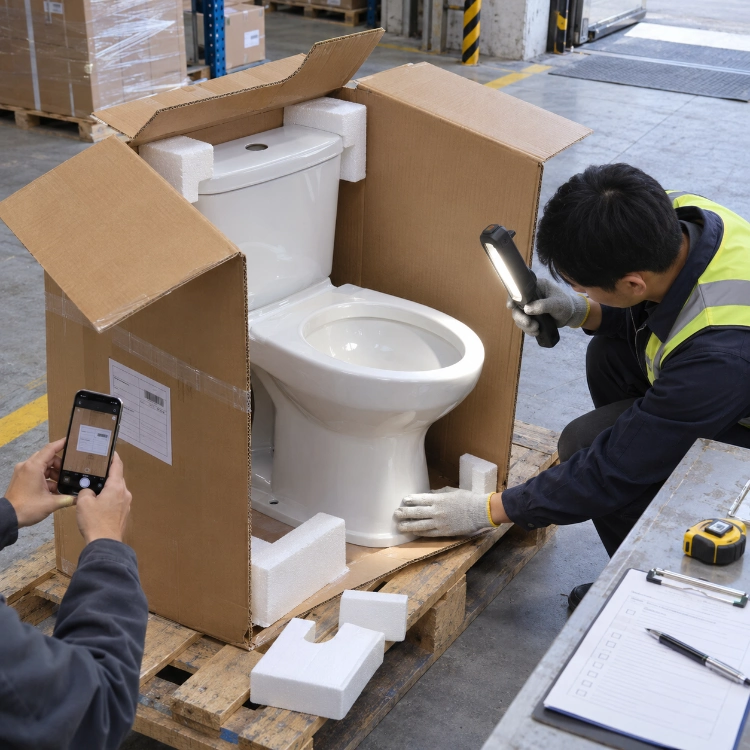
The ceramic edges of a sanitary ware delivery arrive from a maker such as Winway.
An examination on receipt is a set of observations so made and so recorded that a claim for damage may be made upon evidence, and not upon memory.
Open in the Same Direction as the Packing Method
The tape is cut along the seam and not across the middle of a panel, and the blade is kept turned away from the ceramic so that a lid cannot spring upward against the edge. The lid is lifted away rather than torn back, because the packing method is the first record of how the article was arranged. The packing pieces are taken out in the order in which they were laid in and set down beside the carton. A top pad that has shifted, a foam block that is broken at one corner, or a block that is missing altogether is noted before anything is moved further. The person who opens the carton does not clean the article first, since dust, fragments and rub marks are evidence of arrival condition. Where work on the ceramic involves cutting or drilling, the crystalline silica information should be read with the safety team. The category to which an article belongs is identified on the supplier’s official product site.
The article is placed on a clean padded table. The whole surface is seen before the article is turned, so that nothing is missed through changing the position. The article is held at the rim or at a handle that is known to be of full thickness. An article is not tapped, rocked on a hard surface, or pressed at the middle of a panel.
Turn the Ceramic Under Side Light
Side light is used rather than a bright ceiling fitting, because a diffuse overhead light can hide a hairline that runs across a glaze. The inspection begins at the rim and follows the glaze slowly around the article. On a toilet, the fixing lugs, the bolt holes, the outlet and the inlet are examined, together with the base. On a basin, the underside of the bowl and the overflow passage are examined. Where a defect is found, three views are taken: the complete article, the defect in its context, and a close view that shows the edge of the crack or chip with the item code inside the frame.
A fresh break shows a bright, granular surface with no accumulation of packing dust in the low parts of the fracture. Where a carton shows a long compression mark on one face, but the article shows a fracture that could not have been reached through that mark, the carton is photographed as a whole and the two photographs are kept together.
Separate a Glaze Mark From a Broken Body
A dark line on a glazed surface is not by itself a crack. It may be packing transfer, a pencil mark, a dirt deposit, or a feature of the glaze itself. The position and the appearance of the line are recorded before any judgement is made. If the approved cleaning instruction permits a test, the material used and the result are noted and photographed. Where the line remains uncertain, the article is set apart and the supplier is asked for another angle or for an inspection. The acceptance rule belongs to the project specification and the agreed inspection standard. The receiving clerk records, and the authorised quality person decides.
A chip on the rim, or a chip on a bolt hole, exposes the ceramic body. The body is examined for the depth of the chip and for any crack that runs from the chip into the body. A crack that has entered the body is a structural defect and is not handled by a cosmetic rule.
Check Accessories Before the Carton Disappears
A basin, and a toilet may show broken edges around the rim, a chipped glaze edge, or a filled area that differs in shade from the surrounding surface. Some of these conditions are packing damage and some are normal to the production of fired clay. The receiving record states the position of the mark with reference to a feature that can be found again, such as the left rim, the rear of the bowl, or the base edge. Where the same article is inspected later, the earlier entry should stand without being written over, so that the condition at each stage remains visible.
Where an article is purchased against an approved sample, the two are compared under the same light and at the same angle. The comparison covers the shade of the glaze, the surface, the thickness of the rim and the fit of the seat. A variation that is seen under a strong side light and not under a normal view is noted, and the decision is left to the same authorised person. The sample is not handled with dirty hands and is not left in the open air where its colour will change.
Quarantine Without Creating New Damage
The carton contents are compared with the approved component list rather than with expectation. A toilet may include a seat, a fixing kit, a connector, seals or internal fittings. A basin may include brackets or an overflow part, depending on the scope that was ordered. A claim of a missing part is not valid until the list shows that the part should have been present. Sealed accessory bags are photographed before they are opened and are counted. Model and finish labels are kept visible. Where one carton carries parts for several units, the allocation method is written down so that the parts can be traced to the right articles. The scope of what the supplier handles is given in the Winway company profile. A claim of this kind is sent to the supplier through the contact page.
An article with a suspected defect is not returned to the carton with the other articles.
A crack that appears during installation cannot be treated in the same way as one found in the carton.
Write the Claim Before Memories Fade
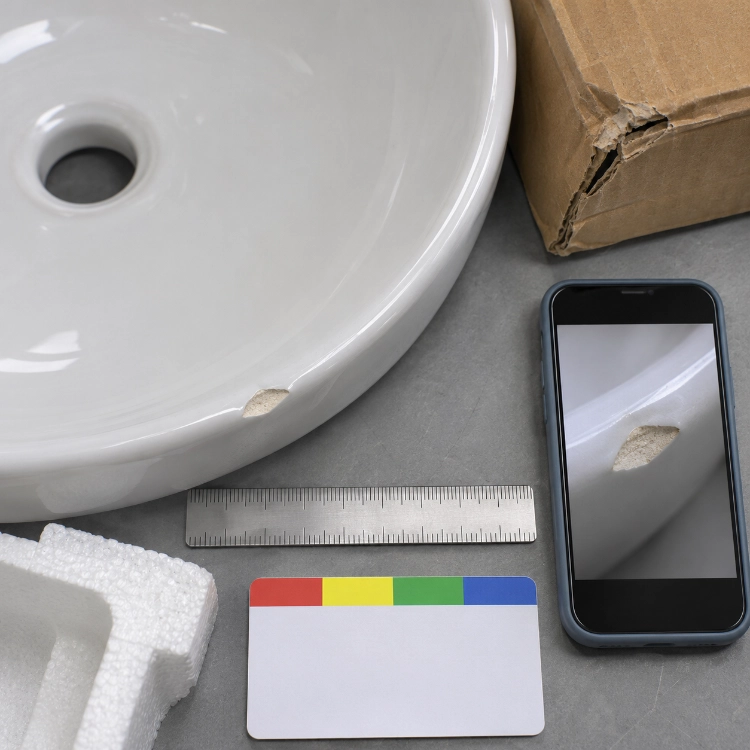
The parts are laid out on a bench in the sequence in which they will be read, and the photograph is taken from above so that the whole arrangement is visible in one frame. A small receiving ruler is placed against the largest part so that scale is fixed within the image. The frames are given plain file names that carry the carton reference and the date. The original files are kept and are not overwritten by later copies. Where a second inspection is made after a conversation with the supplier, the new frames are stored beside the earlier set rather than in place of it.
A note that reads only “damaged” is not sufficient for a claim, because it does not show where the damage is, how it was found, or whether it existed before the carton was opened.
Count Affected Units Without Double Counting
The first note can be short, but it must distinguish what arrived from what was done and from what was concluded. It states what was received, what was opened, and what was observed, and it avoids a confident cause unless the evidence supports one. A note that a crack was found under the left rim at first opening is useful; a note that the factory broke it is not. The purchase order, packing list, delivery note, carton label, container and seal references, closed-carton images, opening sequence, product views and defect views are attached to the note as a set.
The articles that are in doubt are placed in a separate, clearly marked area.
Close the Loop With Replacement Stock
A single broken article can appear in the receiving sheet, the quality sheet and the commercial claim sheet at the same time, and the three entries will not agree unless one identifier is given to the defect and carried through all three. The quantity table carries ordered, received, inspected, accepted, quarantined, broken, missing and pending review, and these numbers must reconcile with one another. A carton still under review is not accepted stock. A replacement promised in a message is not received stock until it has passed its own receiving check.
The receiving record is the record of the condition of the goods at the point of arrival, and it is not a record of opinion. The person who makes the record uses plain terms and places each observation against a feature that can be found again. A record with no answer is more useful than a record with an answer that cannot be trusted.
A record that answers the question of what arrived, where it was seen, and what was done provides the basis for a fair settlement, whether the article is kept, repaired or replaced.
The photographs of the packing and the container taken at loading are kept with the claim, since they show the condition of the goods at the moment of dispatch.
FAQ
Why open the carton in the direction it was packed?
So that the article is lifted out as the packer placed it in, and not dragged over the edge of the carton.
What does side light reveal?
A mark in the surface that a light overhead hides. A raking light shows the glaze that a direct light passes over.
How is a glaze mark told from a break?
A mark that lies in the glaze is read apart from a break that reaches the body of the ceramic, because the two are judged and claimed differently.
Why count the fittings first?
A missing fitting cannot be claimed for once the carton is out of the way. Counting them at the carton is the only reliable moment.
When should the claim be written?
On the day of receipt, with the article named, the defect described and the carton number given, because a claim written later rests on memory.
Conclusion
A claim rests on evidence taken at the moment of receipt. Once the articles are installed and the cartons are gone, the same damage can no longer be proved, and the loss falls on the buyer.
